Mechanical Filtration

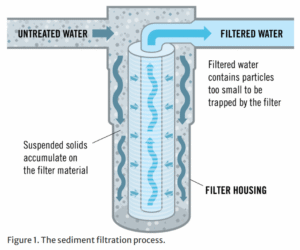
Mechanical water filtration is the first stage of water purification. Removes solid particles from water that are often visible to the naked eye. Mechanical filtration also protects water pipes, faucets, pumps and other household appliances from damage.

The filter medium is usually a polypropylene (PP) cartridge, which traps sand, dirt, sediment, sludge, slime or rust during the flow of water, essentially all solid particles that are larger than the size of holes in the filter cartridge.

Mechanical filters are marked with numerical data, so-called permeability (expressed in micrometers), which indicates the minimum size of the impurity that the filter traps. The lower the number, the higher the filtering capacity of the filter. However, finer filters reduce the water flow more and may become clogged.

For the Quell filter units, you can choose a PP sediment filter 5µm as an option for the first stage of multi-stage filtration. We recommend using it when filtering other than municipal water (eg. well water), if a higher mechanical pollution is expected.

Activated Carbon Filtration

Activated carbon has proven to be an effective solution for removing aftertaste, odor, chlorine, pesticides and some other contaminants. It is one of the most commonly used technologies for drinking water treatment.

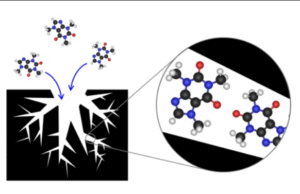
Activated carbon is a black powder or granules made from peat, wood, coal, shells, etc. Coal becomes “active” due to its processing at very high temperatures, which change its structure, porosity and increase the surface area. It is the large area that is an important factor, as it provides more space for the adsorption (binding) of contaminants from the filtered water. A teaspoon of activated carbon can have a total surface reaching the size of a football field.

Relatively low cost and wide availability make activated carbon an excellent medium suitable for a wide range of applications.

Two forms of activated carbon

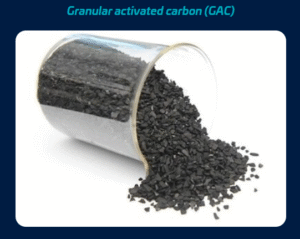
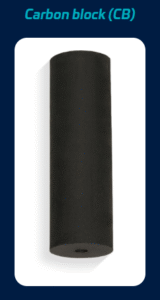
Activated carbon is used in water filtration in two basic forms: granular activated carbon (GAC) and carbon block (CB). Both forms use coal that has been ground into small particles. While for GAC the coal is ground into granules ranging in size from 0.30 mm to 0.84 mm, for the production of carbon blocks the coal is ground into particles up to 19 times smaller (0.045 mm).

The GAC filters are filled with granulate through which the filtered water flows. You will also recognize them by hearing the sound of spilling coal as they shake.

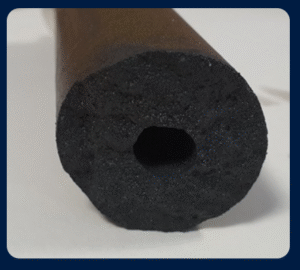
Carbon blocks are made from ground coal and binder under high pressure and at high temperature. The production process is more demanding and slower. However, compression provides greater variability in filter shape.

Why a carbon block is a better choice

In case of GAC filters, the carbon in the filter cartridges is placed freely, so that water flows between the granules without the slightest resistance. The uneven pore structure between individual granules reduces the contact time of water with the filter medium and thus reduces its ability to remove contaminants.

On the contrary, the carbon block of ground activated carbon and fixing binder forms a stable uniform unit with evenly distributed carbon particles. The uniform structure of carbon block forces the water to flow through the static pores and increases the contact time of water with the filter medium, which increases the ability to remove contaminants. The larger number of carbon particles (thus the larger contact area) and their uniform structure allow the carbon block to remove or reduce impurities much more efficiently.

For these reasons, granular carbon is usually used as a method of treating “appearance” contaminants, such as taste, odor and color. GAC filters are most suitable in places with high flow requirements but where it is not necessary to achieve drinking water quality by filtration, e.g. for bathing, toilets and other uses. Carbon block filters go beyond the aesthetic improvement of water by removing particles, parasites, volatile organic compounds and other contaminants.

From the customer’s point of view with GAC filters, carbon dust released during their first use can also be a negative factor. This is because the new filters initially release fine dust from the carbon, which causes a slight coloration of the filtered water. Due to its static structure, the carbon block releases only a minimal amount of fine carbon particles during the first start-up. This minimizes the need for repeated rinsing.

Another advantage of carbon block (CB) over granular carbon (GAC) is that the pore size in the block can be minimized to virtually eliminate the growth of bacteria inside the filter. In case of granular carbon, the free bed can provide enough space for bacteria to colonize.

How does carbon block filter work

The basic filtration process is mechanical filtration. The carbon filter acts as a sieve, where particles larger than the pores of the filter are trapped by the filter. Carbon blocks can also mechanically filter particles as small as half a micron (submicron).

Carbon block filters also use physical adsorption. It is a process in which carbon particles attract and retain the pollutants. This absorption capacity is amplified in some cases by catalytic capacity. For example, chlorine dissolved in water is converted to harmless chloride on the surface of activated carbon.

Carbon Block filters in Quell devices

Activated carbon filtration is the second or the only stage of water filtration in most other filtration devices. The Quell filtration devices use the carbon block filter cartridge as the first stage of filtration. In addition to all its advantages and filtration capabilities, it also serves as the second-stage filtration protection – Disruptor ™, which traps other remaining contaminants.

Disruptor™

Do not compare

Disruptor™ – a unique filtration technology that is not directly comparable to any other filtration technology. It removes more impurities from water than any other mechanical filter, while adding nothing to water and retaining the necessary minerals in it.

Water is becoming an increasingly rare commodity on earth, but it has always been “priceless” in space. Although, water in space has its price and it’s really high – a single gallon of water put into Earth’s orbit costs more than $ 83,000. 

Despite NASA’s innovations that allow astronauts to obtain drinking water from their own urine and sweat and which one day can extract water from underground glaciers on Mars, the availability of water in space is unlikely to exceed its need. Therefore, water recycling and purification methods are among NASA’s main concerns. The Argonide (USA) and Ahlstrom-Munksjö (Finland) companies researching in the field of nanomaterials have developed a unique filter medium, revolutionizing water purification – Disruptor ™. Until recently, it was used exclusively by NASA and was released for commercial use only a few years ago. Disruptor™ filter medium is produced in the USA.

Technology

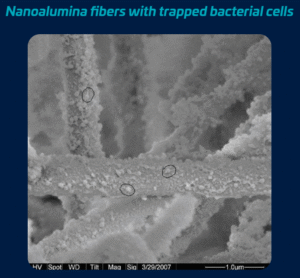
The basis of the Disruptor™ filter medium are nanoalumina fibers made of boehmite material with a diameter of about 2 nanometers (for comparison, a sheet of paper is 100,000 nanometers thick). The surface area of ​​the fibers is 500m2 per gram.

Fibers with a crystalline structure produce a positive electric charge when water is flowing through them. Most impurities have a negative electric charge and are therefore attracted and inactivated by nanoalumina. This process is called electroadsorption. Thanks to this property, a single layer of medium, although having a pore size of about 2 microns, is able to remove more than 99.9% of the particles. The pore size of the filter medium, in relation to the particles it eliminates, means that the Disruptor ™ reaches the grain of the filter medium: high flow (low pressure drop) and at the same time high ability to retain impurities.

The filtration capacity of the Disruptor is enhanced by a layer of powdered activated carbon (to remove odors and aftertaste in water) and also by a layer of antimicrobial disinfectant silver (to prevent the growth of bacteria in filter).

What does Disruptor remove from water?

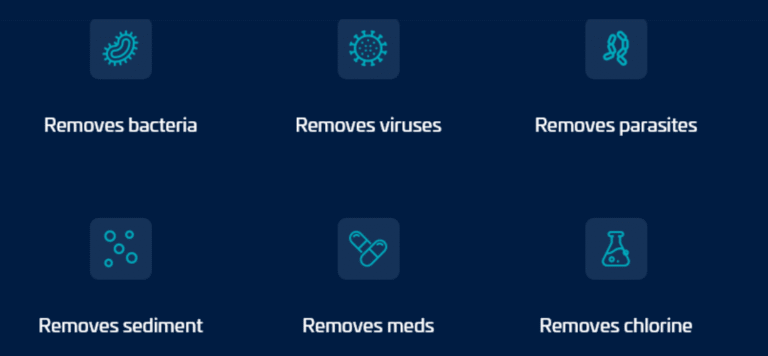
Disruptor™ is a really unique filtration technology that, like carbon filters, reduces chlorine, removes odors from water and improves its taste. In addition, it removes pathogens and other contaminants from water such as bacteria, viruses, cysts, parasites, endotoxins, drug residues, heavy metals (lead, iron, copper).

Other advantages of the Disruptor™ filtration technology

In addition to the high filtration capacity, an important advantage of the Disruptor is the ability to filter not only under pressure but also without water pressure, the so-called gravity filtration method. This allows it to be used in filter kettles or tourist bottles..

Electricity saving. Removing viruses from water usually requires the use of ultrafiltration (UF) or reverse osmosis (RO), which are filtration methods that often require electrical energy to obtain high water pressure. Disruptor ™ does not need electricity for its operation due to its high flow rate and high ability to retain dirt. This also eliminates maintenance activities and minimizes space requirements for the filtration equipment.

Water saving. Membrane filtration technologies (UF, RO) must constantly wash the filtration membrane because it gets clogged quickly. This creates a quantity of wastewater, which is discharged into the sewer system. You will spend an average of four liters of wastewater per one liter of filtered water. Disruptor ™ is one of the sustainable technologies because it works without producing waste and thus saves water and the environment.
... ...


Quell and Disruptor™

All Quell filter devices use the Disruptor™ technology to provide you with the cleanest possible water wherever you need it.